That's a wrap for Everything Open 2026 - thank you for joining us!
That’s a wrap for Everything Open 2026!
We’re delighted that you were all able to join us on Ngunnawal and Ngambri country in Canberra, generously hosted by our Venue Partner, University of Canberra, for #EO2026.
In this post, we’re looking back on the conference highlights, covering the findings from our post-conference survey and looking forward to what’s next.
Conference highlights
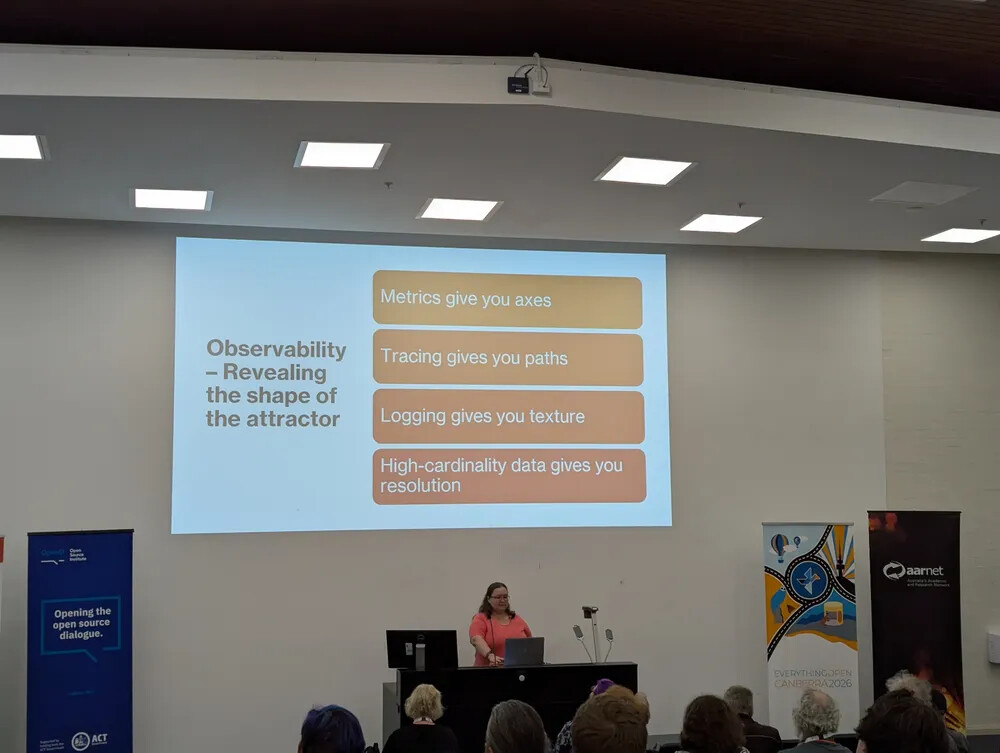
Everything Open 2026 opened on Wednesday 21st January with the Conference Opening, led ably by Conference Director, Miles Goodhew.
Kylie McDevitt - Breaking to Build
CEO and Founder of Canberra information security firm Intersect and long-time co-founder and organiser of hacker conference BSides Canberra, Kylie McDevitt, started proceedings with her excellent keynote. Titled Breaking to Build: What Security Teaches Us About Openness, the over-arching message of Kylie’s keynote is that breaking things matters: it’s important to undertake careful, deliberate exploration of systems to observe how they behave and understand how they work. Using several IoT examples, Kylie demonstrated how she led the development of a rigorous testing methodology for embedded devices, codified in the 2020 IoT Code of Practice. In particular this work highlighted that a key threat to systems are the fragile assumptions we hold about them - and that those assumptions must be validated. She then linked this work to the open source community, arguing that increased diversity and constructive knowledge-sharing helps to surface different threats in a system, which is becoming vitally important as systems become more complex.
Selected highlights from Wednesday
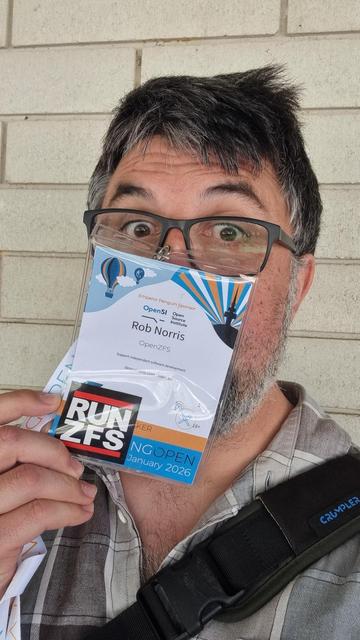
Other noteworthy talks from Wednesday included Jacinta Richardson’s on Chaos Theory and the limits of predictability, where she discusses Chaos Theory and its applications, changing how we thought about predictability in a world that is inherently unpredictable; Associate Professor Vanessa Teague on the Democracy Developers project, where she unpacks the nuances of preferential voting and encourages more people to participate in democratic processes; Jon Oxer on the automatic testing of circuit boards with Testomatic; Dr Jess Moore on SOLID - the social linked data specification for the private, controlled, self-governed sharing of data; Everything Open hardware hacking favourite Kit Biggs showing us how to make a nineteenth-century smartwatch; kernel and ZFS specialist Rob Norris unpacking the unreasonable costs involved in running a business providing open source maintenance services; and AI researcher Dr J Rosenbaum unpacking the scourge of AI slop.
JC Guzman - Next generation Big Data Radio Telescope for Astronomy: Square Kilometre Array Observatory
Wednesday was rounded off with a keynote presentation from Juan Carlos (JC) Guzman - Head of Computing and Software from the the Square Kilometre Array Observatory (SKAO) project.
As JC outlined, SKAO will be the next generation radio telescape for astronomy - delivering state of the art research facilities to help explore the unknown frontiers of science, the formation and evolution of galaxies and fundamental physics in extreme environments. Delivering the SKAO has necessitated state of the art signal processing systems, high-performance compute (HPC) to process the data obtained via radio astronomy to make it useful for researchers - all of which are reliant on open source software.
Linux Australia AGM
Wednesday concluded with the convening of the Linux Australia Inc. Annual General Meeting (AGM), where the new Linux Australia Council was declared elected. Congratulations to:
- Mr Joel Addison - President
- Ms Jenny Cox - Vice-President
- Mr Neill Cox - Secretary
- Mr Russell Stuart - Treasurer
- Mr Harrison Oates - Ordinary Committee Member
- Ms Elena Williams - Ordinary Committee Member
- Mr Johanthan Woithe - Ordinary Committee Member
on your election (or re-election as the case may be).
Dr Keir Winesmith - Peak Text: AI and the Golden Age of Libraries and Archives
Opening Thursday’s programme, Dr Keir Winesmith, Chief Digital Officer at the National Film and Sound Archive, delivered a thought-provoking and insightful keynote where he re-framed our understanding of AI as, alternatively, “archival intelligence” or “averaged inputs”. Using clever examples, such as hilarious mis-interpretations of the Brisbane urban landscape, he demonstrated how generated AI reproduces statistical outputs from its given inputs.
The role of archival institutions - galleries, libraries, archives and museums (GLAMs) is twofold: on one hand, these institutions have provided the rich descriptive metadata and open access images used to train generative AI models, and on the other, these institutions have a duty to protect the truth - the realistic depiction of Australian cultural life in the 2020s. But what happens when the outputs produced by machines are untrustworthy - and now we increasingly rely on generative AI in our daily lives? GLAMs sit at the heart of this paradox.
In his keynote, Dr Winesmith argues that we need better metaphors for AI: it’s not an all or nothing endeavour. AI does some things incredibly well, but it also does some things - like content creation - very poorly. He put forward the concept of “peak text” - the moment we pass from most text on the internet being human written to being generated by AI - as a watershed moment in our cultural history.
Drawing on NFSA’s innovation in the AI space, such as their Bowerbird project for fine-tuning the Whisper automatic speech recognition program, and the Looking for Albo project which draws on work on knowledge graphs for searching the vast NFSA archive, Dr Winesmith held that “maintaining trust in a sea of slop” is a key remit for our cultural institutions, because “truth is not a luxury good”.
Selected highlights from Thursday
Thursday’s programme was rounded out by talks from Hugh Rundle - who showed how his work on the open source BookWyrm project highlighted similar challenges in the library space, such as attracting diverse contributors and contributions; Sae Ra Germaine - whose talk on the international standard for inter-library loans (ISO 18626) showed how international standards are shaping open source inter-operability; and Swapnil Ogale provided best practice examples of how to construct the perfect README.md file.
Penguin Dinner
On Thursday evening, delegates were hosted in the University of Canberra Refectory for a night of renewing acquaintances, meeting new members of the community and unpacking the day’s talks.
A particular highlight of the Penguin Dinner was the music provided by pianist, Micah Knight. You can listen to more of Micah’s music on YouTube.
Emma Davidson - Open source can have friends everywhere
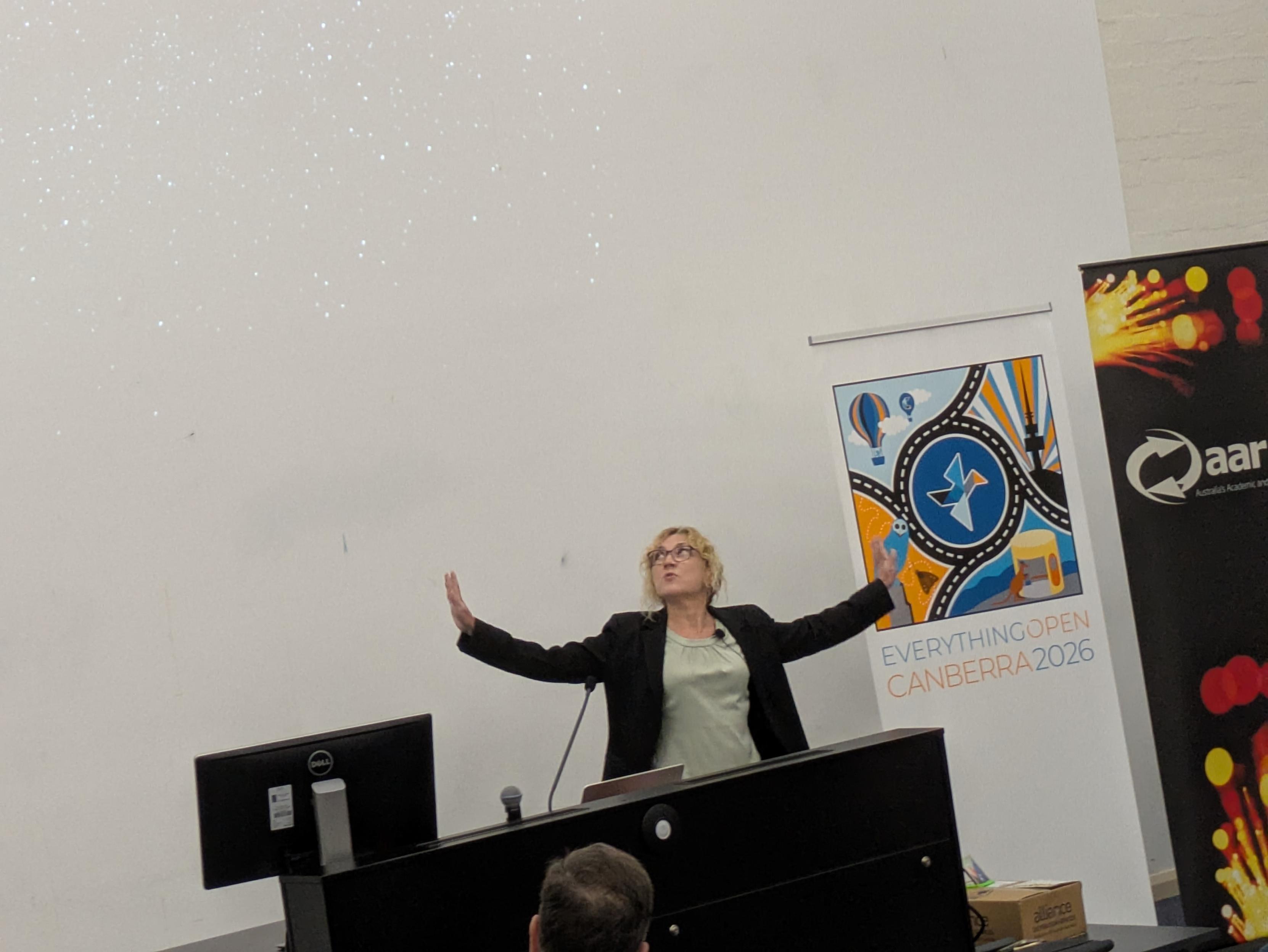
Friday morning was opened by IDEATE Program Director and former Greens MLC, Emma Davidson. Poignantly, Emma introduced her talk in three languages - English, Auslan (sign language) and Ngunnawal, showing that different languages help communities intersect.
Emma’s key message is that open source software is a positive externality. That is, the benefits of open source software accrue inequitably to the consumers of open source software rather than the maintainers, and that we need funding of open source software for it to be sustainable. Her argument was that the government would derive outsize returns from investing in open source software, rather than other large projects whose benefits were questionable.
Turning to diversity in open source, Emma showed that diversity here was lower than the tech industry overall, and to increase that diversity we needed not just technical capacity but the ability to build communities. Key to that task, Emma argued, was the need for better online skills sharing and documentation, and team leadership competencies such as inclusivity, respect, being explicit about values, and welcoming all backgrounds and skill levels.
Selected highlights from Friday
Other noteworthy talks from Friday’s programme included Chair of Open Australia Foundation, Donna Benjamin, discussing the history of the Open Australia Foundation, its goals and activities, and the benefits it delivers to all Australians in transparency and accountability. Long-time RepRap contributor and 3D printing expert, Vik Olliver, introduced the Rep Rap Micron, a multi-material 3D printer that makes millimetre-scale objects with micron-scale precision. Kathy Reid, Head of Applied ML and AI research at Mozilla Data Collective, delivered a tutorial on fine-tuning the Whisper speech recognition engine to better recognise Australian speech.
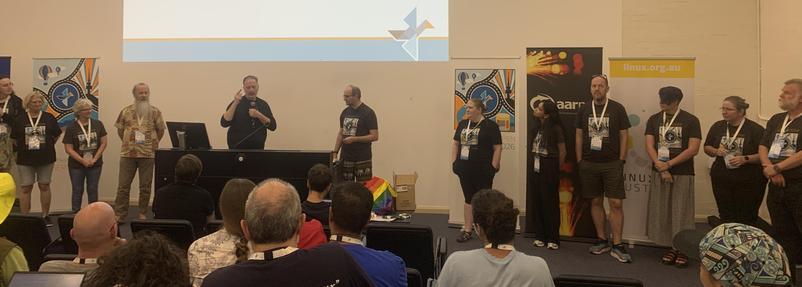
Steven De Costa - Everything Open, Everywhere, All at Once
Founder of Link Digital and long time CKAN contributor, Steven De Costa, locknoted Friday’s proceedings with his thought-provoking talk, titled “Everything Open, Everywhere, All at Once”. Here, Steven argued that openness isn’t just a technical choice, but an epistemic and ethical stance. That is, reality exceeds our knowledge of it, and that collaborative, transparent systems are the best way to navigate that gap and expand our understanding.
Conference videos and photos
Videos from the talks have now been published to YouTube, where we have permission from Speakers to do so. They will also be uploaded to the Linux Australia mirror in due course, when we have volunteer capacity to do so. Thank you for your patience. Conference photos are available at this link. We send thanks to photographer Leonard Low for all his excellent work here, and you can see more of his portfolio here.
Post-conference survey findings
In the interests of continual improvement, we asked all Speakers, Delegates, Volunteers and Organisers to fill out a short post-conference survey. This survey was similar to the ones administered in 2024 and 2025, providing longer-term trends to inform the continual improvement of Everything Open.
Number of Delegates and breakdown of Ticket Types and sales
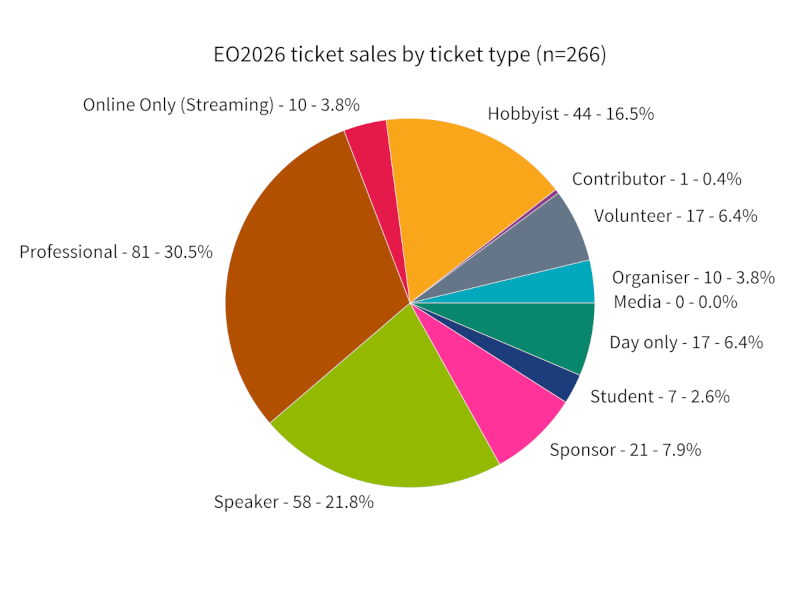
Everything Open 2026 attracted around 270 Delegates, down around 10% from Everything Open Adelaide 2025. We see this as a positive result, given both Canberra’s population of around 490,000 compared to that of Adelaide of around 1.4 million, and the ongoing economic constraints.
The decline in Delegates attending Everything Open via online streaming (10 or 4% in 2026, compared to 17 or 16% in 2025 and 39 or 22% in 2024) strongly brings into question the benefit of providing online streaming for Everything Open, which places additional audio visual demands on the volunteer organising team. However, this needs to be balanced with the inclusion benefits that streaming provides where Delegates are unable to attend in person for various reasons.
Comparing sales by ticket type in 2026 to 2025 and 2024, we note that the percentage of Delegates attending on a Professional ticket type (81 or 31%) in 2026 has remained steady with 2025 (90 or 30%). We do not see this increase as a signal of an improving external economy: our planning assumption is that sponsorship and Professional attendance will continue to be constrained in the short-term due to inflationary pressures and geopolitical instability.
We have include the zero count of Media Tickets to better allow comparison in future years.
Survey response rate
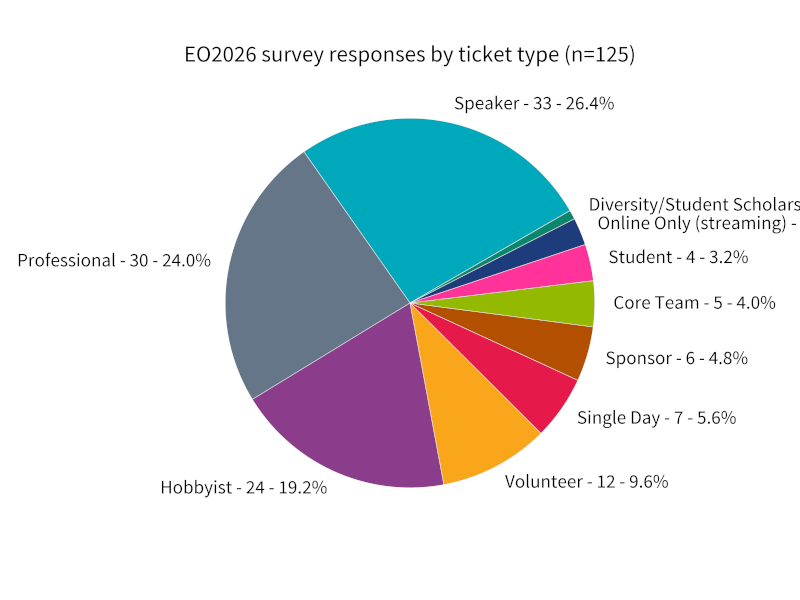
Overall, as shown in Figure 2, we had a response rate of around 58%, which we’re delighted with. We have responses from all Delegate types except Contributors. Given the small number of Contributors, Contributors may not have wished to self-identify as this Delegate type to protect privacy. Given the high response rate and coverage of Delegate types, we believe the survey results are robust.
How did people find out about Everything Open?
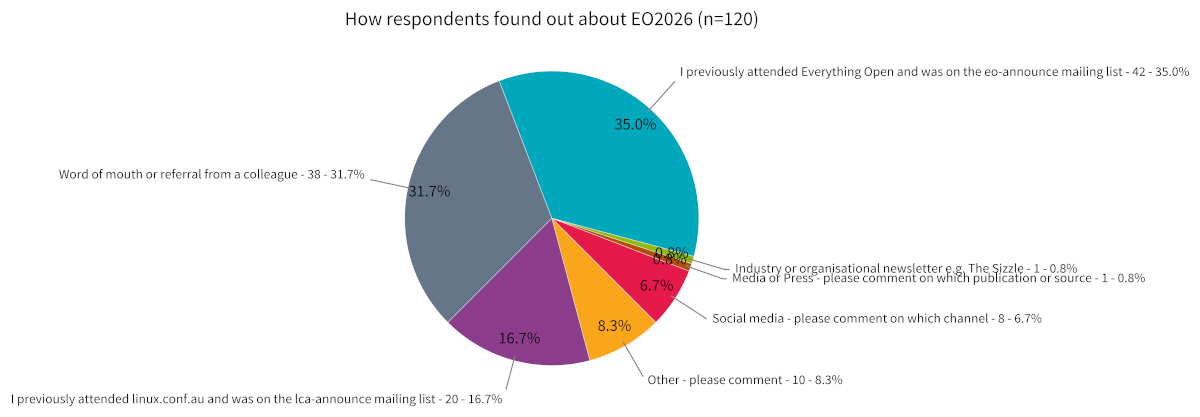
Looking at how people found out about Everything Open 2026 in Figure 3 above - data which informs decision-making around promotional efforts and spend - the dependency on mailing lists for brand awareness is still very marked, but appears to be declining (17% lca list, 35% eo-announce list, total of 52% in 2025, compared to 58% in 2025 and 68% in 2024). This year, we observed a large increase in word of mouth referral for event promotion (32% in 2026, compared to 17% in 2025 and 18% in 2024). Generating word of mouth referrals for future Everything Open events is likely to be a fruitful activity for future teams, but it’s not immediately clear how to approach this. Reliance on social media appears to have dropped significantly (7% in 2026, 15% in 2025, 7% in 2024), likely due to the ongoing fragmentation of the social media landscape.
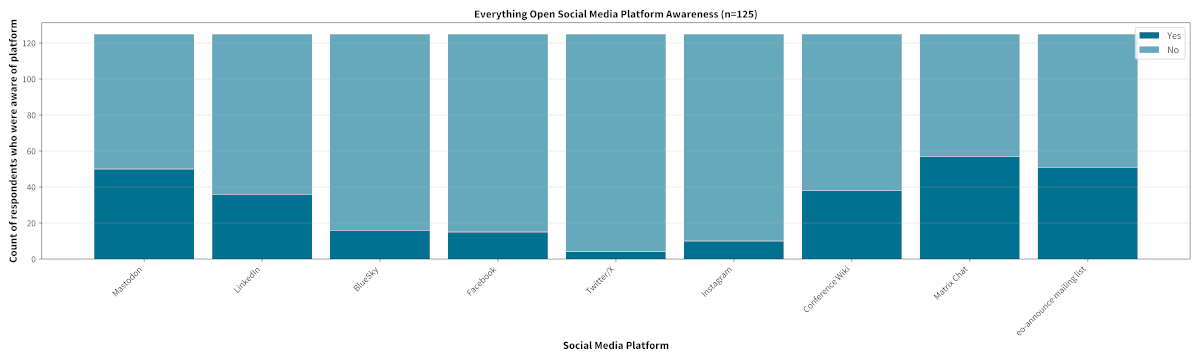
In order to help prioritise conference communications activities in the future, the survey for the first time this year included a question on awareness of Everything Open social media and communication channels, shown in Figure 3.2 above. We can see that the Matrix conference chat service, eo-announce mailing list, the Conference Wiki, Mastodon and LinkedIn were the communication channels Delegates were most aware of, and these should be prioritised in future communications. These results further underscore last year’s recommendation to shutter the Everything Open Twitter account, following precedence by both other Linux Australia auspiced events and Linux Australia itself.
Quality and relevance of the conference program
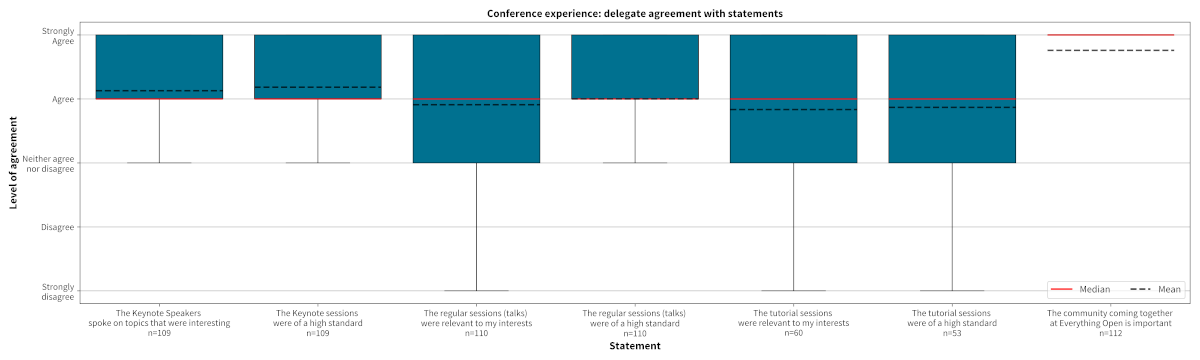
To gauge the quality and relevance of the conference offering (Keynotes, Tutorial and regular sessions), we asked Delegates to state their agreement with several statements, the results of which are shown in Figure 4 above. The Keynotes were very highly rated for both relevance and quality, although open-ended feedback indicated widespread confusion with the key messaging of one particular Keynote talk. Regular sessions were rated generally high for quality, but there was more variability in relevance. Tutorials rated less highly than Keynotes or regular Sessions on both relevance and quality, representing a challenge for the Everything Open Session Selection Committee in future years - as it’s harder to attract high quality tutorial proposals than those for regular Sessions. The desire for the community to come together was very highly rated (this rating has no interquartile range (IQR) box because the answers were so tightly grouped: it’s not an anomaly).
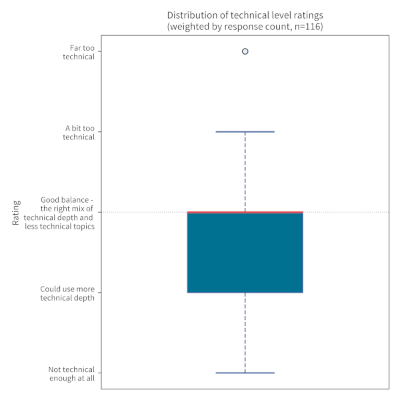
Based on Everything Open 2025 survey results, where a tension between satisfaction with the breadth of the topics covered at Everything Open and the technical depth of talks was noted, we explicitly added a question to the survey this year to get stronger data on this point. The results of this question are shown in Figure 4.2, indicating that while the majority of respondents felt the technical balance was just right (70 of 116), there was a significant cohort who felt more technical depth was needed (38 of 116), with a smaller cohort indicating the programme was not technical enough at all (4 of 116).
This quantitative data was also borne out through triangulation with open-ended feedback:
“The talks I went to were mostly alright but I do have the feeling there were less talks aligned with my interests than old LCA. I’d like to have more kernel hackers back. Talk descriptions should have an explicit statement of the prerequisites/target audience to help people select sessions that are appropriate for them.”
“My first time at the conference, and I was expecting more technical talks, but some of the talks I attended were pretty non-technical, and often also ventured into personal and political agendas, which made me uncomfortable.”
“Lack of deep technical talks. The CXL talk from PJ Waskiewicz was the only really technical talk I went to , and it wasn’t that deep.”
We note here that having a more deeply technical conference programme for Everything Open is tightly bound to the Call for Sessions process: the Session Selection Committee can only add a Session to the Schedule if they receive a proposal for it - and we call on the community to encourage Speakers they would like to see to submit to the Session Selection process. This year, we received 116 proposals for 40 available talk slots - an acceptance rate of around 26%. The downside to having more Session submissions is a lower acceptance rate - which can inhibit Speakers from applying - another trade-off.
Session timing and makeup
Open-ended feedback also indicated a desire for more, shorter regular Sessions.
“4 tracks is too many for a 300 person conference. Not every talk needs to be 45 minutes long by default, sure some need 45 minutes, but they should be few and far between, like the tutorials. I’d argue you can have almost as many talks, if each slot was 30 minutes long, and only 3 tracks. It’d also encourage people to really focus on what they’re trying to say.”
” A 45 minute default slot is too long, without experience or mentorship, they can be disengaging, because they give people too much leeway. 30 minutes encourages people to focus on the core of their talk. Additional technical details can be given as part of a workshop, or as part of follow up blogs.”
Aversion to talks about AI and AI-generated slide content
We noted a key theme in the open-ended feedback indicating an aversion to both talks about AI and AI-generated slide content. The Session Selection Committee will take this feedback under advisement for 2027 and beyond.
“The use of AI imagery or content in talks was incredibly disappointing, if talks are going to use AI content or be about AI not covered in the agenda they should be updated as such.”
“The program (and some of the talks) seemed rather AI heavy, both in selected talks and invited talks. I realise there’s still a massive AI bubble, but it’s disappointing to see AI hype pushing out the “individual developer” / “open source teamwork” technical talks from previous years.”
“I would have liked to see GenAI use disclosures so that I could choose whether or not I wanted to see talks based on that. I’m not denigrating the people who have used it, but I also don’t want to fill my eyes with more slop than I’m already forcibly exposed to due to the current state of the internet without my informed consent. This was a big thing that really disappointed me about this year.”
We note here that there were concerted and deliberate efforts to attract submissions centred on open source and sovereign AI. This action was driven mindful of both AI fatigue and the growing phenomenon of AI slop, but also the need to ensure that open-source and libre-focussed technologies have a role in shaping the the AI landscape, avoiding proprietary lock-in.
Quality of the conference experience
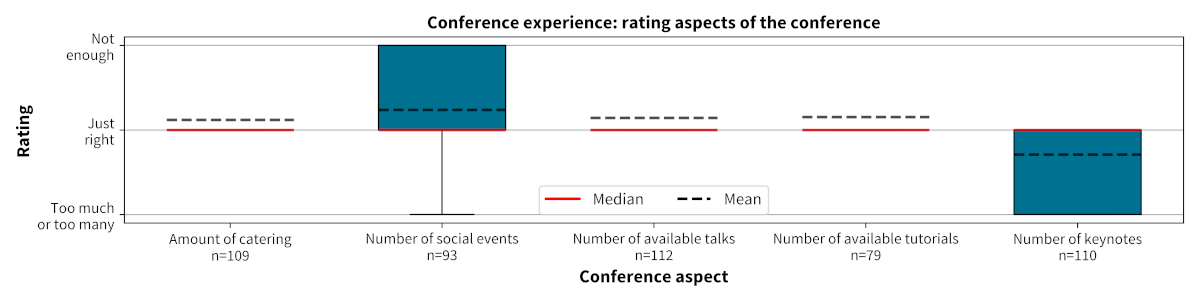
Next, as shown in Figure 5, we asked Delegates to indicate how aspects of the conference such as catering met their needs.
Catering of lunch and Penguin Dinner
Responding to feedback from the 2025 conference where a strong desire to have the conference lunch catered was noted, the conference team this year made the decision to fully cater the conference. The amount of catering appears to have met expectations here, and is also borne out in the open-ended feedback:
“Lunch catering saved a lot of time and effort, and provides more opportunities for spontaneous socialising / networking with all attendees rather than only going with existing friends to eat offsite.”
“Dietary options were pretty good (though I did have concerns that cross contamination might be a problem for some, and the trope that vegan peeps must love mushroom/eggplant continues, regardless still a lot better than other events). Catered lunch really helped people spend more time together and less time trying to get food - I think this should continue.”
“Lunch included. Keeps people together, increases “hall track” interactions.”
“The catering was wonderful - the provision for alternative dietary requirements had a lot of variety and tasted great, would thoroughly commend whoever selected and organized that. Having lunch at conference was also very much appreciated, even though I know this adds extra load to the organizing team.”
“The added lunch catering this year was great to have, the coffee cart super and handy, and the new dinner entertainment was just divine. Also it was the right type of music, nice in the background. That young lad is so talented. Definitely keep doing the lunches, if possible.”
“Lunch included. Keeps people together, increases “hall track” interactions.”
“Fully catered is good, makes it easier to mingle with others during breaks and not get separated into different groups.”
We do note, however, that catering adds a large cost to the conference and that we can only make the decision to have the conference catered if it is financially viable to do so - such as via sponsorship or an increase in ticket prices.
Social events
The survey question related to the number of social events available indicated a strong desire for more social activities in the conference programme. Tools like the Matrix Chat and the Conference Wiki were made available to help Delegates self-organise social activities, with several Birds of a Feather (BoFs) running during lunchtime. There was very little mention in the open-ended feedback around the BoFs and self-organisation, and we may need a separate feedback question on that next year. Our operating assumption is that the Matrix Chat and Conference Wiki made it easier for Delegates to self-organise, and that future conferences will be able to integrate these tools into their communications earlier in the conference life-cycle.
“I know it was a bit hard to organise and one more task for the organisers when they had a lot on their plate, but…The wiki came late and there was no link to it from the main conference webpage. You had to look at a news item to find it. I hope now it’s there and we have a domain name it will be easier in future years and better used.”
Number of Keynotes, Tutorials and regular Sessions
The survey question results indicate that the number of Tutorials and Sessions is about right, but that fewer Keynotes may be better in the future. The Session Selection Committee will take this under consideration.
Conference Schwag
Next, we asked for written feedback about the conference Schwag available on RedBubble. The feedback indicated delight with the conference logo - with many thanks to Jenny Cox for her work here. The key theme from the open-ended feedback was a desire by Delegates to have basic Schwag - T-shirt and stickers - included with the conference registration fee and provided at registration.
“Do what the rest of the conferenes do and do screen printing and include as part of the ticket or add on.”
“The selection of different swag is a plus but it would still be better if t-shirts were provided for in-person delegates, as is the case for other LA conferences.”
I like the fact that swag is available that way, and not automatically given out. I think the t-shirt design looked really great - although I’d like to have known if it was produced by a human artist (and if so, who). If it was produced by AI, I think that’s highly inappropriate.”
For transparency, the organisers determined that not bundling a t-shirt in the conference package was a more sustainable approach as not every attendee wants or needs a t-shirt. Given the additional overhead for conference organisers to arrange Schwag to be available at Registration, and the additional pressure it puts on ticket prices, Schwag is not likely to be available at Registration going forward, and we will rely on the RedBubble store instead, unless there is additional organiser capacity.
Attending or recommending a future Everything Open event
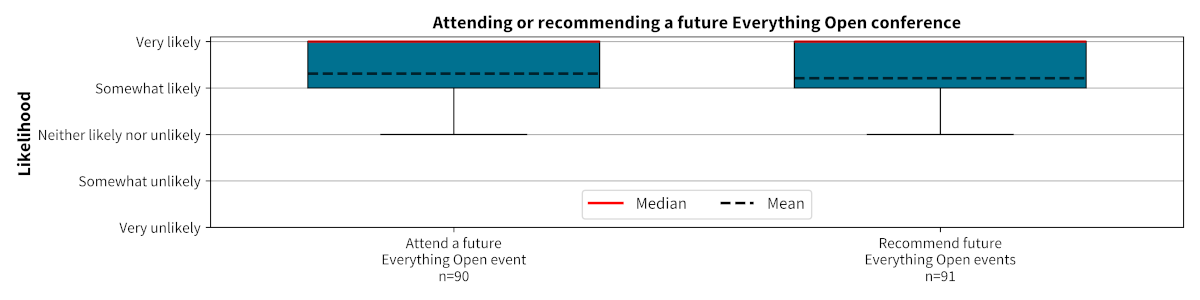
Turning to whether people would attend an Everything Open conference or recommend one to a colleague in the future (see Figure 6), we found a very high likelihood of both - which bodes well for the future!
Other themes in the open-ended feedback
Several other themes that were not covered directly in the above questions were expressed in the open-ended feedback:
Onsite psychologist
Several Delegates commented favourably on having the ability to speak with a psychologist at the conference:
“In house psych. Way good.”
“Having a psychologist on site was an amazing low friction way to talk to someone! Especially considering they’re someone who has experience in the industry, and seeing a professional otherwise can cost more than the lower end ticket prices.”
“The psychologist on site was an excellent resource, and the psychologist picked was a perfect fit for me and likely most of the attendees.”
If budgets allow, this is something we will look to continue going forward.
Venue and hallway track
There was broad satisfaction with the return to a University venue from that of a professional conference centre and how it facilitated the informal “Hallway Track” of conversation and connection.
“The return to a university venue was fantastic. It feels a bit smaller and sort of “messier*, which I thought helped. If nothing else,are the hallway track a lot more interesting, as there was lots of opportunity to bump into new people. Dormitory accomodation is also great, cheap and lends itself to late night chats and hacking.”
“The level of inclusiveness was open and much appreciated. The facilities were of high standard and very much lent themselves to the successful operation of the conference.”
Diversity, equity, inclusion and public health considerations
Several Delegates commented favourably on the inclusivity of the event:
“I presented as a different gender for the first time ever and literally nobody mentioned it. Lots of compliments.”
“Reports on the CO2 levels in the rooms (which was mostly a single person crowdsourcing the information this year).”
“Love the inclusive and friendly atmosphere. Appreciate the talks about improving society - we can to easily get lost in the purely technical.”
“It was well-run, mostly easy to find may way around. Congrats to the organisers and volunteers. Loved the approach to gender and toilets, even though I’m not affected by it.”
Lightning Talks
Several Delegates indicated a preference for having more time assigned to Lightning Talks:
“The Lightning Talk format seemed a little TOO rushed, presenters had to plow through their material, deal with frequent interruptions, and there was no time for clarifying questions. Given that it was pitched as a great exercise for first-time speakers and unpolished topics, it seemed overtly hostile to both of those things.”
“Not enough BoFs… More lightning talks would be nice.”
Conference videos
Echoing calls from previous Everything Open conferences, Delegates were keen to see videos online as soon as possible.
Hosting Everything Open alongside other open source community events
One suggestion made by a Delegate was that Everything Open could form part of a broader “Open Source Week”, helping to facilitate smaller open source communities to have a presence where they are not of a scale to hold their own event. This feedback will be passed on to Linux Australia.
“I would like EO to be seen as a vital event by the technical communities this conference serves, not just the geographic community of Australian and New Zealander open source participants in general. LCA, in its glory days, attracted a critical mass of participants from certain projects, e.g. the kernel (for which we could fill a whole miniconf day with speakers), which gave it potential as a useful place for technical and organisational collaboration for members of those projects. It doesn’t feel like this is the case any more. We have seen the rise of community-specific events (e.g. PyCon) taking much of that energy, but some communities aren’t large enough to have their own dedicated event. I have previously suggested in mailing list discussions that one way to advance this would be to keep EO as a central cross-community event, but to augment it by making it the centre of an “Australian Open Source Week” or something similar, helping projects to organise their own adjacent events (more than the old LCA miniconfs, but smaller than a full scale conference, funded and resourced separately from EO). I haven’t heard much explicit discussion about what the longer term vision is, and I think now is the time to have that discussion. Above all though, thanks to the organising team for making this happen for another year - I realise I’ve given a lot of feedback but I also haven’t put my hand up to actually go and organise a conference in many years. It’s a lot of work and we do value it.”
Praise for Organiser and Volunteer efforts
Delegates were full of praise for the efforts of the Organising Team and Volunteers:
“Everything was very well run. I love how well it stuck to time. The volunteers were all amazing and helpful.”
“I attend a number of Linux conferences around the world each year, and the community feel and organic style of how this conference comes together still feels awesome. While the quality of running the conference continues to increase, you haven’t lost that organize feel. Please don’t lose it.”
“Huge thanks to Sae Ra, Pete, Steve, Erin, and so many other folks behind the scenes. Love your work. Huge congrats to Organisers - it’s a huge amount of work to put on a conference - and appreciate your time.”
“Thank you all so so so much. It was a fantastic conference and I hope you all feel incredibly proud of your efforts. ❤️”
“Was so awesome to get to spend time in person with so many good folks in the community. Thanks so much to everybody who put in so much work to make this happen. This was an amazing opportunity and it was great to get back to Canberra, where I grew up.”
“I’ve never been before, and I thought this was top-shelf. Good speakers, relevant topics, competent staff (the inevitable technical difficulties barely slowed anybody down, which is awe-inspiring) and the resources like the WiFi network and conference schedule were always on, and easily accessible. You’ve clearly also spent years attracting a group of friendly, intelligent, and welcoming souls to attend year-over-year. It’s wise these days to judge people by the company they keep, and as a sole data point, you appear to keep very good company. I hope to attend again in the future.”
“This was probably one of the best foss conferences I ever attended :)”
“Thank you to all the awesome organizers, fantastic attendees and generous sponsors. The conference was very well organized.”
“This was my first time at Everything Open and it was a lovely experience. Everyone was very kind and supportive, and there was a very relaxed but engaged vibe. Very enjoyable. The organisers did a great job.”
“HUGE thanks as always to all the organisers & other volunteers who make EO possible. It’s an enormous undertaking and your efforts – individually & collectively – are enormously appreciated. 💕”
“I really appreciate the responsiveness and willingness to help from all of the volunteers and staff of the conferences. They are always so friendly, very helpful, and very clearly work hard to bring the best experience possible for attendees. This is still one of my favorite Linux and technical conferences to attend each year, and look forward to it all the time. I for one want to say thank you.”
Note: these are direct quotes for transparency. Where identifiable information about a particular Speaker or Organiser or Volunteer has been given, it has been redacted for privacy at the author’s discretion.
Thank yous and next steps
Everything Open would not happen without a huge amount of voluntary effort from many people. Our Organising Team worked diligently 6 months to a year out from the conference, co-ordinating venue, sponsors, speakers, keynotes, ticket sales, communications and media, audio visual and much, much more. During the conference itself, our Volunteers provided Registration Desk, Room Monitoring, Audio Visual and Streaming, ushering and many more tasks too numerous to mention. Thank you.
A huge thank you to our Sponsors - AARNet, ARM, Code Construct, Red Hat, Western Digital, Fastmail, Google, Penten Amio, ChainGuard, Adfinis, Malware Security, The Sizzle, Open Source Institute and all our In-Kind partners.
We would also extend deep gratitude to the Session Selection Committee - a team of dozens of contributors, led by Sae Ra Germaine and Donna Benjamin - who scout for sessions and Speakers, encourage submissions and curate an compelling conference programme. If you’d like to be involved in the Session Selection Committee, or have ideas for excellent Speakers, please get in touch with the Linux Australia Council.
And last, but not least, we’re thankful to you - our Delegates and Speakers. Thank you for submitting talks and the many hours it takes to prepare and practice them. Thank you for convincing your bosses to send you. Thank you for sending yourselves. Thank YOU.
Everything Open 2027
We will be bringing Everything Open back in Brisbane in early 2027, and we will be announcing specific dates and venue details in the coming weeks.
If you’d like to be a part of the organising team, we’re always on the lookout for skilled and dedicated Organisers willing to give around an hour or two a week in the months leading up to the conference - just drop us a line at contact@everythingopen.au.
Keep an eye on the Everything Open website for more information.
Stay in the know
You can keep up to date with all the Everything Open happenings in the following ways: